Every large language model, every self-driving car system, and every AI-powered diagnostic tool has one thing in common that rarely makes the headlines: somewhere behind the polished demo, a human being sat down and labeled the data that taught the machine how to think. In 2026, that human element has become more central to AI development, not less. As models grow more capable, the industry has quietly shifted its hardest questions away from “can we build this model?” toward “can we trust the data that trained it?”
This article pulls together what several of the field’s most detailed 2026 reports are saying about data annotation, AI training work, and the global workforce making it all possible. Whether you are curious about the industry from a business standpoint, considering data annotation as a source of income, or just want to understand what is actually happening behind the AI tools you use every day, this is the full picture.
Why Data, Not Just Models, Became the Main Event
For years, AI progress was framed as a race between labs building bigger and cleverer model architectures. That race has not stopped, but a second, quieter one has taken over much of the industry’s attention: the race to produce training data that is accurate, diverse, and trustworthy enough to support these increasingly powerful systems.
Reports estimate that roughly 80 percent of machine learning effort today goes into data preparation and labeling rather than model design itself. That statistic captures a real shift in priorities. Teams have learned, sometimes painfully, that even the most sophisticated neural network is only as reliable as the humans who guided its training. There have been well documented failures in healthcare diagnostics and autonomous vehicle systems, and in most of these cases, the root cause was not a weak algorithm. It was mislabeled or incomplete training data that failed to capture the messiness of the real world.
That lesson has reshaped how serious AI teams operate. The question is no longer simply whether a model can be built. It is whether the data behind it can be trusted, audited, and defended if something goes wrong.

The Annotation Landscape Is Getting More Complex
A few clear trends define where data annotation is heading this year.
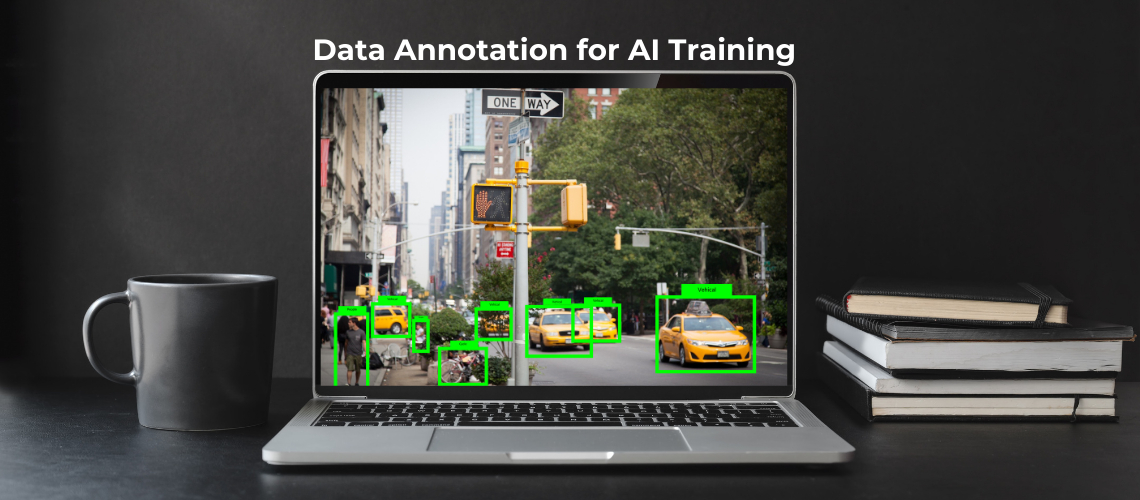
Models are multimodal, so labeling has to be too. Today’s AI systems increasingly combine text, image, audio, and video simultaneously. Think of an autonomous vehicle’s cockpit system, which needs to understand a driver’s spoken command, their eye movement, and the external road environment all at once, and keep those signals consistent with one another over time. Annotators are no longer just tagging isolated data points; they are managing relationships between different types of data within a single, unified context. That is a meaningfully harder task than labeling a static image, and it demands more sophisticated tools and training for the people doing the work.
Regulation has entered the picture in a real way. By August 2026, key provisions of the EU AI Act affecting high-risk systems came into force. Article 14 of that legislation requires that high-risk AI systems be designed for effective oversight by what the law calls “natural persons,” meaning real human beings, not just automated checks. AI developers carry the legal responsibility for compliance, but in practice this means they need annotation partners who can supply genuine human verification, along with a documented trail proving who reviewed each label and how bias was addressed. Traceability, once a nice-to-have, is now closer to a baseline expectation for any team operating in regulated markets.
Synthetic data has limits, and teams are learning them the hard way. As demand for training data has exploded, many companies leaned on AI-generated synthetic data to fill the gap at scale. The problem is a phenomenon researchers call model collapse, where a model trained too heavily on its own outputs starts amplifying its own errors instead of learning from reality. The fix that is gaining traction is a hybrid approach: use synthetic data for volume, but anchor it with a smaller, carefully curated set of human-labeled data that keeps the model grounded in how the real world actually behaves.
Generalist labeling is giving way to expert labeling. A label is only as good as the judgment behind it, and for high-stakes domains, that judgment increasingly needs to come from people with real expertise. Medical annotation, for example, often requires radiologists or pathologists who can spot subtle tissue variations that a non-specialist would miss entirely. Legal and financial applications increasingly rely on professionals in those fields to label reasoning and compliance markers correctly. The days of treating all annotation work as interchangeable, low-skill microtasks are fading, at least for anything feeding into serious, high-stakes systems.
How Teams Are Measuring Quality Now
Consistency used to be the bar for good annotation work. In 2026, that bar has moved to something closer to mathematical accuracy. Teams increasingly rely on formal inter-annotator agreement metrics to quantify how reliable their labeled data really is. Cohen’s Kappa is used to measure agreement between two annotators, while Fleiss’ Kappa serves the same purpose for larger teams. For the highest-stakes tasks, many organizations now use a double-blind consensus process, where two annotators label independently and a senior expert steps in to break any ties.
Standards bodies have caught up too. The ISO/IEC 5259 series now provides a global framework for AI data quality, and best practice increasingly means documenting three things clearly: semantic accuracy, meaning that a label genuinely represents the real-world concept it claims to; data provenance, meaning a clear record of who labeled the data and what qualified them to do so; and completeness, meaning the dataset actually represents rare edge cases, not just the easy, common examples.
There has also been a shift toward what some teams call “shift-left” quality assurance, which simply means catching problems early instead of at the end of a project. Rather than building an entire dataset and discovering ambiguous instructions only after review, teams now run small pilot batches, sometimes called gold sets, specifically to surface confusing edge cases before scaling up. Combined with active, real-time feedback loops between the people managing a project and the people doing the labeling, this helps prevent what practitioners call instruction drift, where annotators slowly interpret guidelines differently over the course of a long project.
Automation Has a Real Role, But It Has Not Replaced People
It would be easy to assume AI has simply automated its own training process, but the reality is more nuanced. AI-assisted tools now routinely handle the first pass of labeling, the roughly 80 percent of cases that follow clear, predictable patterns. That leaves human annotators to focus on the harder 20 percent: ambiguous cases, ethical edge cases, and situations that require genuine reasoning rather than pattern matching.
Automated labeling is fast and effective for bulk, repetitive work, but it carries a real risk of quietly reinforcing its own mistakes if left unchecked. Human-in-the-loop review remains critical for edge cases, ethical auditing, and anything where nuance matters, and it is the only approach that satisfies the “natural person” oversight now required by regulation for high-risk systems in the EU. In short, the two approaches are converging rather than competing. Fast, cheap automation handles scale, while human judgment handles the parts that actually determine whether a model can be trusted.
Who Is Actually Doing This Work
Behind every one of these trends is a large, genuinely global workforce, and this is where the industry gets interesting from a labor and opportunity standpoint.
For years, generative AI development was heavily English-first. Foundation models learned primarily from English text, benchmarks were built in English, and the resulting productivity gains disproportionately benefited English speakers, creating what researchers have called a digital divide affecting the roughly 1.5 billion people who do not speak English as a primary language. That is changing quickly. Demand for multilingual data annotation is surging, driven partly by AI labs based in China, Japan, and Korea pushing hard into non-English markets. Crucially, straightforward translation does not work for this kind of labeling. Models need original-language annotation work done by native speakers who understand cultural context and natural phrasing, not text translated after the fact. As a result, the outsourcing map for this work is widening well beyond the traditional hubs, with growing annotation activity in Central Asia, across Africa, and in Latin America. This work now spans far more than chatbot training; it touches text, audio, image, and video annotation across a wide range of applications.

On the consumer-facing side, a handful of platforms have become the dominant on-ramps for individuals who want to do this work directly. DataAnnotation, Outlier AI (which is operated by Scale AI, one of the largest AI data infrastructure companies), and Alignerr (powered by Labelbox, a long-established enterprise labeling company) are the three most recognized names in 2026. All three are legitimate, paying companies, and the underlying work covers a range of tasks: rating which of two AI responses is more helpful or accurate, writing example prompts and ideal responses for a model to learn from, correcting factually wrong or biased AI outputs, labeling images, audio, or text with descriptive categories, and applying professional domain expertise, whether that is coding, law, medicine, or linguistics, to judge whether an AI output actually meets a real professional standard.
Realistic pay for this work in 2026 ranges from about ten to twenty dollars an hour for general annotation tasks, twenty to forty dollars an hour for skilled writing and evaluation work, and forty to eighty dollars an hour or more for specialist expertise like coding, legal, or medical evaluation. It is worth noting, though, that per-task pay tends to look better on paper than it feels in practice. Once you account for unpaid time spent hunting for available tasks, reading detailed instructions, and occasionally redoing work that gets rejected at submission, most contributors report an effective hourly rate that runs twenty to forty percent below the advertised numbers.
Getting onto these platforms can also be its own challenge. Onboarding timelines vary wildly, from a few days to several weeks, and in some documented cases, applicants never hear back at all. None of the three major platforms currently guarantee a response timeline. The most honest assessment of this work is that it suits confident writers, native speakers of in-demand languages, and people with genuine domain expertise who want flexible side income and are comfortable navigating imperfect, opaque application processes. It is a poorer fit for anyone who needs predictable, guaranteed income, anyone outside the specific countries these platforms actively recruit from, or anyone looking for a first job with a clear path for advancement and manager support. This is piecework, not a traditional career ladder, though the broader industry surrounding it is genuinely well funded and still growing.
The Bigger Picture
Step back far enough, and a consistent story emerges across all of this. AI is not simply automating itself into existence. Every meaningful advance in model quality is still underwritten by human judgment somewhere in the pipeline, whether that is a radiologist confirming a subtle diagnosis, a native Yoruba or Swahili speaker making sure a model actually understands regional phrasing, or a contributor correcting a chatbot’s confidently wrong answer at two in the morning.
As regulation tightens, as models become more multimodal, and as AI labs push further into non-English markets, that human layer is not shrinking. It is becoming more specialized, more accountable, and in many cases, better compensated for the expertise it requires. Whether you are running a business that depends on trustworthy AI, working in a field where AI tools are becoming unavoidable, or simply looking for a flexible way to earn income that touches the AI economy directly, understanding this layer of the industry is no longer optional. It is quickly becoming one of the more important stories in tech.