
If someone had told me during secondary school that I would eventually find myself addressing rooms full of people, pitching ideas, representing ideas, and taking on speaking responsibilities, I probably would have found it hard to believe.
Not because I lacked ideas or had nothing to say, but because I knew myself. I was naturally introverted. I was more comfortable observing than participating, listening than speaking, and staying behind the scenes than being the centre of attention.
Interestingly, I was not the student who struggled academically. Quite the opposite.
My name is Alaka, Chiemezuo Grace. I had my secondary school education at Community Secondary School, Umuoghara and this is my story.
I was a straight-A student. Almost every term, I maintained an average of about 98 per cent and took first position in my class. And the funny thing was that I did not always feel I was trying particularly hard. Academic excellence came quite naturally to me. I understood my lessons, performed exceptionally well in examinations, and consistently maintained my position at the top.
In the classroom, I was comfortable. Give me an exam, an assignment, or a challenge, and I knew what to do.
You would never find me awake at midnight studying. In fact, I was the worst person to have as a reading partner during night prep. For context, we were in a boarding school, and we had three hours (6PM-9PM) allocated for evening studies. But somehow, I would manage to sleep through almost the entire three hours!
I would wake up, gather my things, and head back to the hostel, where I would proceed to enjoy what I considered a much more deserved and uninterrupted sleep, as though I hadn’t just spent the entire evening sleeping.
The funny thing is that, despite my questionable relationship with night prep, I consistently maintained excellent results. I was one of those students who didn’t necessarily need to sacrifice sleep to do well.
To this day, most of my classmates still cannot understand how I managed to pass my exams when I barely ever read. I mean, I didn’t read during the day, and I certainly didn’t read at night. Night prep was practically my sleeping period! Even I sometimes wonder how I pulled it off. 😂
But put me in front of an audience and ask me to speak? That was an entirely different story.
I would rather sit quietly, listen to everyone else, and contribute absolutely nothing. For some people, they had thoughts, opinions, ideas, and more importantly, the zeal to want to talk, but expressing them before a crowd was not something they naturally looked forward to. But me, I had absolutely no interest in expressing anything in front of anybody.
It is interesting how someone can be so confident with a pen and paper but a total blunt when it came to speaking.
When I look back at those years, I realise that some of the most defining moments of our lives do not necessarily come with grand announcements. Sometimes, they arrive as ordinary opportunities that we almost turn down because we do not believe we are capable of handling them.
For me, one of those moments came when I was unexpectedly called to host a social gathering involving our Principal, teachers and some NYSC corps members serving in the school.
Unlike other days with other people, I was not informed days earlier. There was no advance notice, no opportunity to prepare, and certainly no time to rehearse an opening speech.
Unlike other occasions where people might have had days to prepare, I was not given that luxury. There was no advance notice, no opportunity to prepare, and certainly no time to rehearse a speech.
As it turned out, the senior student who was originally supposed to host the gathering fell ill on the very day of the event. And, naturally, the teachers needed a replacement. Someone had to step in.
Now, on my list of unfortunate events, this was probably number 1.
But seriously, what were the odds right?
What were the odds that a finger pointed randomly in my direction would land on me? And what were the odds that, despite my best efforts to hide behind taller students ( I was quite small), that finger would somehow locate me?
What were the odds that the owner of that finger would confidently call out my name, especially when I wasn’t even in the same class as the original host?
Apparently, the odds were 100 per cent!
All my carefully planned escape strategies failed before they even began. I could have sworn I was practically invisible, but somehow, I had been discovered.
And this teacher? Oh, this teacher was determined!
I begged. I fidgeted. I tried to look as helpless as humanly possible. At some point, I even developed a sudden and very urgent need to use the toilet. You would think all these were reasonable grounds for reconsideration.
Absolutely not!
The teacher had made up her mind. I was going to host that gathering, and apparently, no amount of pleading was going to change that decision.
There I was, a perfectly innocent student who had come to enjoy an ordinary school day, suddenly being recruited into a job I had neither applied for nor prepared for.
And just like that, my peaceful day was over.
It happened exactly in the moment, And I was forced to figure things out as they came
.
THE INVITATION I NEVER SAW COMING
I remember being called up to the podium and feeling like I was going to faint. It was one of those situations where you barely have enough time to process what is happening before everyone expects you to take responsibility.
One moment, I was simply going about my day, and the next, I was expected to take charge of a social gathering involving people I respected.
My immediate reaction was nervousness.
I wondered why I had been chosen. There were other students who were naturally outspoken, expressive, and seemingly more comfortable addressing people. Why would anyone consider me for such a responsibility?
I was academically sound, yes. But hosting a gathering was not an examination. There was no guide to prepare me on the right words to say.
I was going to have to speak.
And I had to do it in front of the school principal, teachers and corps members.
I remember the feeling of having to gather myself almost immediately. I did not have the luxury of spending days thinking about how to approach the responsibility which was a blessing to them because I would have probably faked an illness to try and get away from it. There was no time to develop a perfect opening or imagine how the audience would respond.
Looking back, I think that was one of the first lessons that experience taught me: sometimes, opportunities do not wait until we feel ready.
Sometimes, they arrive unexpectedly, and we have to decide whether to embrace them or retreat into what is familiar.
That day, I stepped forward.
THE EXCLAMATION THAT CHANGED EVERYTHING
When I eventually found myself standing before the audience with all eyes on me, reality began to sink in.
I could see the teachers, the corps members, and the other people gathered. Suddenly, I became very conscious of myself.
What exactly was I supposed to say?
How was I supposed to begin?
Would I make a mistake?
Would they take me seriously?
My mind was racing, and because I had not prepared beforehand, I had to find a way to start the gathering naturally.
Then came the moment.
Instead of delivering some sophisticated introduction or attempting to sound like an experienced MC, I blurted out something completely unexpected:
“ ATOKWANU M OO!” I don’t know what a perfect translation for this would be, but it could lightly mean” I am finished!”
For a split second, I wondered whether I had just embarrassed myself.
Then the room erupted in laughter.
The teachers laughed. The corps members laughed. Even those who had been sitting quietly suddenly became more relaxed.
And something happened to me.
I laughed too.
The tension I had carried onto that stage began to disappear. I had walked into the room worrying about what everyone would think of me, but that one unexpected statement changed the atmosphere.
It became an icebreaker I had not planned.
I realised that I did not have to sound perfect to connect with people. I did not have to pretend to be someone else or force myself into a personality that was not mine. So, I lightly but cautiously followed it up with: “Good day, everyone! Please, if I make any mistake today, remember that I am still a student. I hope nobody is planning to sack me”
I simply needed to be present, engage the audience, and enjoy the moment.
From that point, I became more comfortable. I started introducing activities, interacting with the audience, making spontaneous remarks, and keeping the gathering lively.
The more I spoke, the more comfortable I became.
Before I knew it, I was enjoying myself.
What had initially seemed like an assignment I was not prepared for had become an experience I was proud of.
That day, I discovered something I had not previously considered: perhaps I was capable of more than I had given myself credit for.
It was not that my introversion suddenly disappeared. I was still the same person. But for the first time, I had experienced what it felt like to stand before an audience and realise that I could actually hold their attention.
I left that gathering with something more valuable than the satisfaction of having successfully hosted an event.
I left with a little more belief in myself.
FROM HOSTING A GATHERING TO JOINING THE DEBATE SOCIETY
What I did not know at the time was that the gathering would become a stepping stone to something much bigger.
That experience gave me a little confidence and made me more open to opportunities that involved speaking in front of people.
Eventually, I found myself becoming part of the school’s Debate team.
Now, if hosting a gathering had been intimidating, debating was an entirely different challenge.
A debate required preparation, critical thinking, confidence, and the ability to defend an argument. It meant standing before an audience, sometimes against people who were equally prepared, and presenting your position convincingly.
You could not simply smile, make a joke, and hope the audience would forget your nervousness.
You needed substance.
You needed to know what you were talking about. You needed to organise your thoughts, communicate them clearly, listen to opposing arguments, and respond intelligently.
Interestingly, my academic background helped me in many ways. Being accustomed understanding concepts and performing well academically gave me an advantage when it came to researching debate topics and organising arguments.
However, I still had to learn how to communicate those ideas effectively.
Knowing something and being able to explain it convincingly are two different things.
I had to learn how to structure my points, support my arguments, and think beyond the first thing that came to mind.
With every practice session with or teachers and coaches and every opportunity to speak, I became better.
Eventually, I began representing Community Secondary School, Umuoghara, in several debate competitions.
Those competitions became some of the most memorable experiences of my secondary school years.
We competed against other schools, listened to different perspectives, defended our positions, and learned from every encounter. There was something particularly exciting about wearing your school’s identity and knowing that you were speaking not just for yourself but for an entire institution.
With time, our set became recognised as one of the best groups of debaters in the tournaments we participated in.
It was a beautiful feeling.
Whenever I think about those experiences, I cannot help but appreciate how far I had come. The girl who once struggled to imagine herself having all attention on her was now standing before judges and opposing teams, confidently presenting arguments on behalf of her school.
I had not planned that journey. I had not even imagined it.
But one opportunity had introduced me to another, and each experience was preparing me for something bigger.
THE INTROVERT WHO BECAME THE SCHOOL SENIOR PREFECT
Just when I thought my journey had already taken an interesting turn, another opportunity came.
I eventually became the Senior Prefect (SP).
For anyone who knew me during those days, this might have seemed a little surprising.
I was still an introvert. I was not necessarily the loudest person in a room, and I did not suddenly become someone who enjoyed every form of attention.
I still valued my quiet moments. I still had situations where I preferred to observe rather than speak.
But something had changed.
I had started understanding that being reserved did not mean I was incapable of taking responsibility or leading others.
Being a school prefect came with responsibilities that required communication, confidence, and a willingness to engage with different people.
There were students to relate with, teachers to communicate with, instructions to pass across, and situations that sometimes required me to speak on behalf of the school.
I had to learn how to carry myself, express myself clearly, and take responsibility for the position I occupied.
And perhaps the most interesting part was that people who knew me understood that this was not necessarily my natural comfort zone.
But I did it.
Looking back, I realise that those experiences were gradually teaching me a lesson I still carry today:
You do not have to lose your personality to develop your confidence.
You can be an introvert and still be an effective communicator. You can enjoy your personal space and still command a room when necessary. You can be naturally quiet and still become a leader whose voice carries weight.
Confidence does not require you to become a completely different person. Sometimes, it simply requires you to become comfortable expressing the person you already are.
BEING ACADEMICALLY BRILLIANT DOES NOT AUTOMATICALLY MAKE YOU A CONFIDENT SPEAKER
One thing I find particularly interesting about my story is the contrast between my academic performance and my initial struggle with public speaking.
I was that student who could consistently take first position every term and perform exceptionally well without necessarily putting myself under excessive pressure.
Yet, I could still feel nervous when asked to address a gathering.
It taught me that intelligence and communication are not the same thing.
You can be brilliant and still struggle to articulate your ideas before an audience. You can understand complex subjects and still find it difficult to explain them to other people. You can have excellent academic results and still need to develop the confidence to speak up in a meeting.
Our educational experiences sometimes place so much emphasis on getting the right answers that we forget to develop the ability to communicate those answers effectively.
We learn to read, write, memorise, analyse, and pass exams. These are important skills, but they do not automatically prepare us for every situation life will eventually demand of us.
At some point, we must learn to present our ideas, defend our opinions, negotiate, persuade, and communicate with people from different backgrounds.
That is why I have come to appreciate public speaking as a life skill rather than simply a talent for people who enjoy being on stage.
It is a skill that complements intelligence.
What is the value of a brilliant idea if you cannot communicate it to the people who need to hear it?
What is the value of an excellent proposal if you cannot confidently present its benefits?
What happens when you have the right answer but are too afraid to contribute when it matters?
These are questions I have found myself thinking about over the years.
And they are part of why my interest in public speaking has grown beyond my personal development.
THE PART OF THE STORY THAT PEOPLE DON’T ALWAYS SEE
One thing I want to be honest about is that I have not completely overcome introversion.
Sometimes, when people hear about my experiences in debating, hosting, leadership, and public speaking, they might assume that speaking has become effortless for me.
It hasn’t.
There are still moments when I have to prepare myself mentally before addressing an audience. There are still situations where I experience nervousness, especially when I am speaking to unfamiliar people or when the outcome of the conversation is particularly important.
Sometimes, I still have to fight the urge to remain in the background.
The difference, however, is that I have learned not to allow those feelings to determine what I can or cannot do.
I have come to understand that confidence is not necessarily the absence of fear. Sometimes, it is the willingness to do what needs to be done despite the fear.
Over the years, I have found myself in situations where I have had to make pitches to people, present ideas, speak on behalf of others, and communicate with individuals whose decisions could influence the direction of a project or an opportunity.
There have been moments when I needed to convince someone of an idea, explain the value of something, or represent a vision that required people to believe in it.
These are responsibilities that demand more than simply knowing what to say.
You need to understand your audience. You need to communicate with clarity. You need to build confidence in the person listening to you.
And every time I find myself in such situations, I remember that my journey started with a simple school gathering.
It reminds me that growth is often a collection of small experiences that prepare us for opportunities we cannot yet see.
WHY MELUORA HUB’S PUBLIC SPEAKING CLUB MEANS SO MUCH TO ME
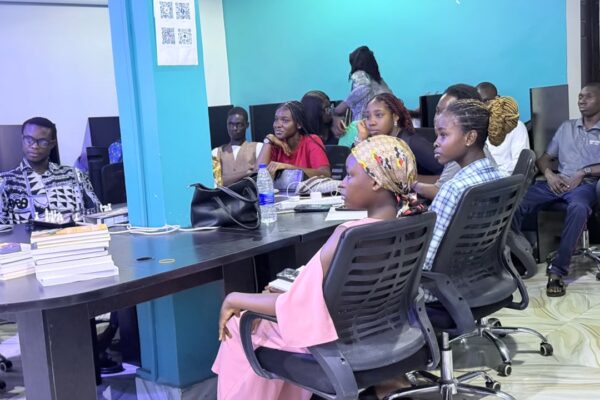
This brings me to something I am particularly passionate about: the Meluora HUB Public Speaking Club.
My involvement with the club means more to me than simply being part of an organisation that encourages people to speak confidently.
It connects directly to my personal experiences.
Sometimes, I think about my secondary school days and wonder how much easier my journey could have been if I had access to an environment like this back then.
I wish I had something like the Meluora HUB Public Speaking Club growing up.
I wish there had been a space where students could practise speaking without feeling embarrassed about making mistakes. A place where an introverted student could gradually discover their voice, where someone who struggled to introduce themselves could learn how to address an audience, and where young people could develop communication skills long before life began demanding those skills from them.
I wish I had a community where public speaking was not reserved for the naturally outspoken students.
Because the truth is that many people have incredible ideas, brilliant minds, and valuable perspectives, but they struggle to communicate them.
Some are afraid of being laughed at. Some worry about making grammatical mistakes. Some struggle with stage fright. Others simply do not know where to begin.
And sometimes, all these people need is an opportunity, a supportive environment, and someone willing to help them practise.
That is what I find meaningful about what we are building at Meluora HUB.
The Public Speaking Club provides an opportunity for people to learn, practise, interact with others, make mistakes, receive feedback, and improve.
It creates room for people who may never have considered themselves good speakers to discover that they can become better communicators.
And I find that particularly important because I know what it feels like to be the person who needs that opportunity.
I know what it feels like to have something to say but worry about how it will sound when it comes out.
I know what it feels like to be conscious of everyone watching you.
I know what it feels like to need a little push before taking the microphone.
That is why I do not see public speaking as merely teaching people how to stand on a stage.
It is about helping people develop the confidence to express their thoughts, communicate their ideas, participate in conversations, defend their positions, and make their voices count.
It is about preparing people for situations they may not even realise they will encounter in the future.
Because not everyone will become a professional speaker, an event host, or a debate champion.
But almost everyone will eventually find themselves in a situation where they need to communicate effectively.
It could be a job interview, a business meeting, a classroom presentation, a project defence, a proposal, a pitch to a potential investor, or even a conversation where they need to stand up for themselves.
The ability to communicate confidently is useful far beyond the stage.
And I wish more young people understood this early enough.
If I had the opportunity to meet the younger version of myself at Community Secondary School, Umuoghara, I would probably tell her a few things.
- I would tell her that being quiet is not a disadvantage.
- That she does not need to become the loudest person in the room to be heard.
- That making mistakes while speaking is not the end of the world. Sometimes, the very thing you say out of nervousness might become the moment that changes everything.
- I would tell her to accept more opportunities, even when she feels unprepared.
- And most importantly, I would tell her not to underestimate the power of practice.
I would encourage her to join more speaking communities, participate in conversations, ask questions, share her opinions, and expose herself to situations that challenge her communication skills. I would tell her that confidence is built, not inherited.
And if I could give her one more thing, it would be a community like Meluora HUB.
A place where she could learn, grow, and discover her voice without feeling that she had to be perfect.
Perhaps that is one of the reasons I am so passionate about creating and sustaining opportunities like this today. I know what it would have meant to me growing up, and I would love for other young people to have access to the opportunities I wish I had.
I want someone who currently struggles to speak in public to look back in a few years and realise just how much they have grown.
I want someone who thinks they are too shy to lead to discover that they can confidently take responsibility.
I want someone who is afraid of making a presentation to eventually find themselves making pitches, defending ideas, and influencing decisions.
And I want them to understand that they do not have to wait until they are adults before developing these skills.
The earlier we start, the better prepared we become.
ONE OPPORTUNITY CAN CHANGE EVERYTHING
When I look back at my journey, I realise that it did not begin with a debate competition, a leadership position, or a major presentation.
It began with an unexpected invitation to host a school gathering.
It began with a straight-A student who was comfortable taking first position in class but was not particularly comfortable being the centre of attention.
It began with a nervous girl on a podium, struggling to find the right words, and making an unexpected exclamation that sent the entire room into laughter.
That moment gave me the courage to try again.
Trying again introduced me to the Debate Society. The Debate Society gave me opportunities to represent my school. Those experiences helped prepare me for leadership as the Senior Prefect. And the lessons from those years continue to influence how I approach communication today.
I am still learning. I am still growing. I still have moments when I need to push myself beyond my comfort zone.
But I am grateful for every experience that has helped me become a better communicator.
And I am particularly grateful that my journey has given me a reason to care deeply about helping others develop the same confidence.
Perhaps this is what makes the Meluora HUB Public Speaking Club so meaningful to me. It represents the kind of opportunity I wish I had when I was younger.
It is a reminder that we can create the spaces we once needed, and that the experiences we wish we had can become opportunities we provide for others.
So, if you are someone who struggles with public speaking, someone who has brilliant ideas but finds it difficult to express them, or someone who has always preferred to stay in the background, I want you to know something:
You do not have to figure it all out today.
You do not have to become an excellent speaker overnight.
You only need to be willing to start.
Take the microphone. Introduce yourself. Share your opinion. Volunteer to speak. Make the mistake. Learn from it. Try again.
You might be surprised by what one opportunity can unlock.
I found mine at Community Secondary School, Umuoghara, somewhere between nervousness and an unexpected blurt.
Today, through Meluora HUB, I hope to help others find theirs.
Because sometimes, the greatest thing we can do with the confidence we have developed is to create opportunities for someone else to discover theirs.
We are building the kind of public speaking community we wish we had when we were younger.
Your voice matters. It deserves to be heard. And it is never too early or too late to find it.